
How to Sync Your Outlook Calendar With Google Calendar (2026 Guide)
·
There are three workable ways to get your Outlook events into Google Calendar in 2026, and each makes a different tradeoff between simplicity, freshness, and control. This guide walks through all three with screenshots, then covers the gotchas that bite people most often — recurring events, time zones, work-account restrictions, and what happens when invitees reply.
Quick answer
- One-time copy: export Outlook to an
.icsfile and import it into Google Calendar. Works in 15 minutes. No ongoing sync. - Read-only subscription URL: publish the Outlook calendar and add the ICS URL to Google as a subscribed calendar. One-way, refreshes every 8–24 hours, can’t be edited in Google.
- Automatic two-way sync: use a sync tool like XCalSync to keep both calendars updated in near-real time, with filters to control which events copy.
If you only need to move historical events once, use the ICS import below. If you need ongoing visibility, skip to the subscription method or automatic sync.
Going the other direction (Google → Outlook)? See How to sync your Google Calendar to Outlook.
Trying to merge two Outlook calendars instead? See How to sync and merge multiple Outlook calendars.
Method 1: Export and import (one-time copy)
This is the only built-in option that copies your entire Outlook calendar into Google in one go. It’s a snapshot — events created or changed in Outlook after the export won’t appear in Google.
Step 1: Export your Outlook calendar to an ICS file
The export flow differs slightly between Outlook on the web, Outlook desktop, and Outlook for Mac. The web flow is the most reliable, so we’ll use that.
Outlook on the web (outlook.com or Microsoft 365 web)
-
Sign in at outlook.com and open Calendar.
-
Click the gear icon in the top-right and pick Calendar settings.
-
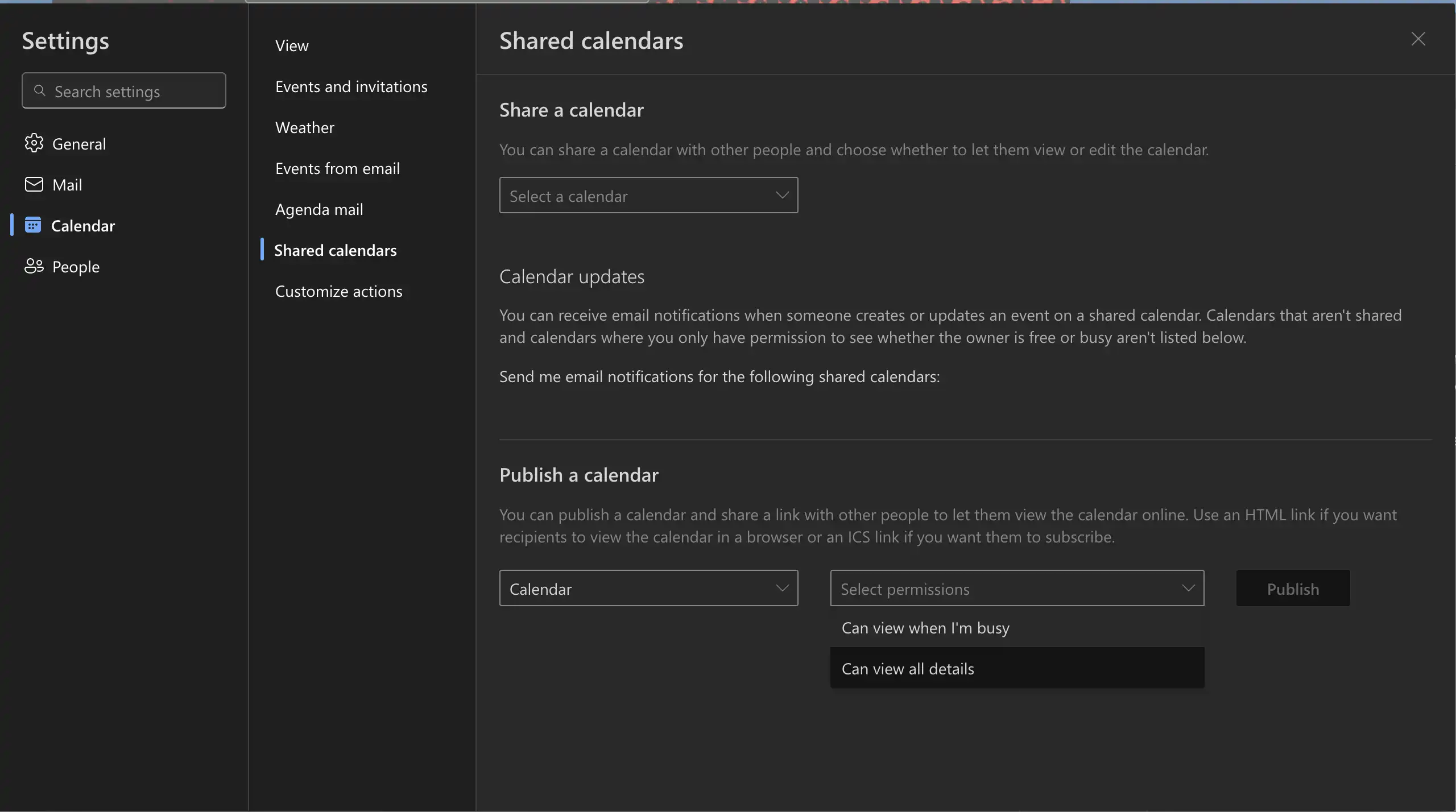
From the left menu, choose Shared calendars.
-
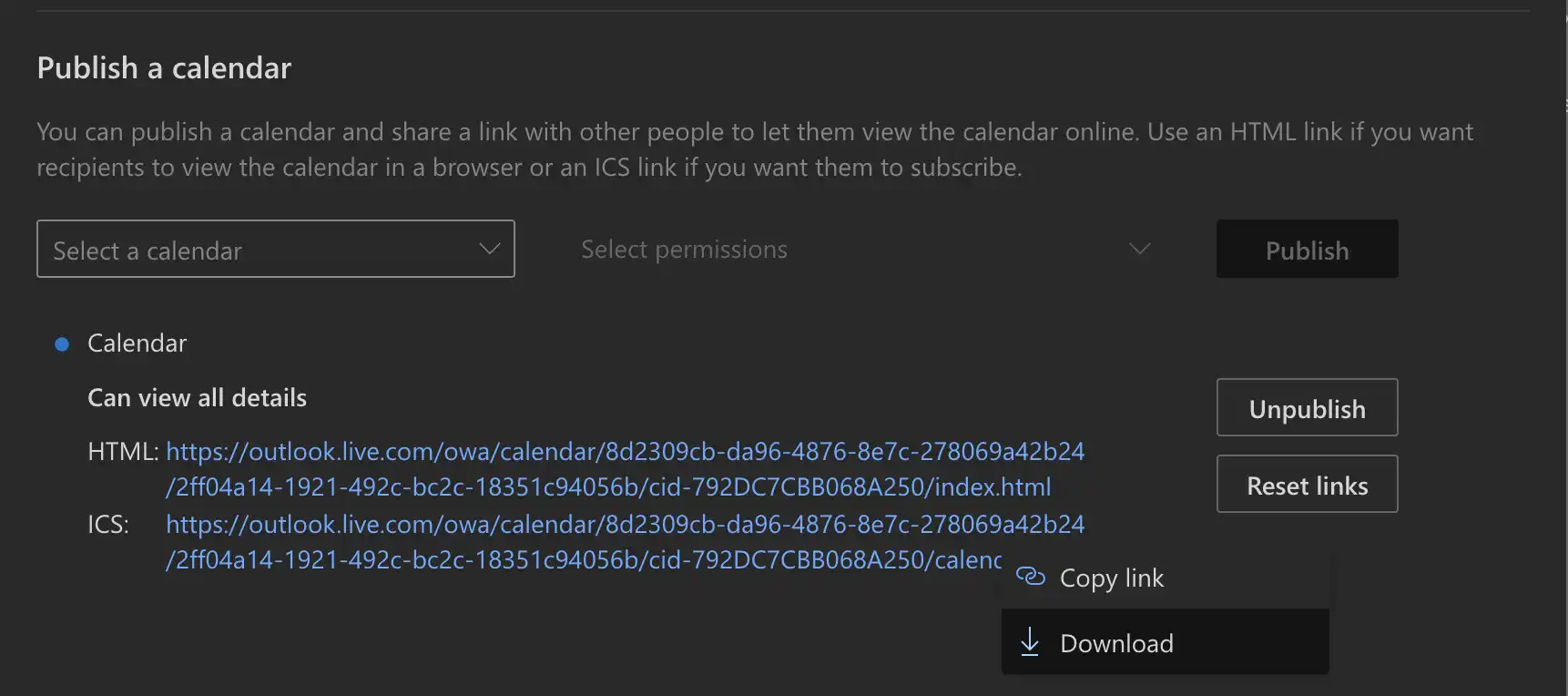
Under Publish a calendar, pick the calendar you want to export, set permissions to Can view all details, and click Publish.
-
Outlook generates two URLs — one HTML, one ICS. Click the ICS link, then choose Download.
-
A
.icsfile lands in your Downloads folder. Rename it something obvious (outlook-export-2026-05-08.ics) so you can find it in the next step.
For privacy: once the import is done, return to Shared calendars and click Unpublish. The ICS URL is unguessable but not authenticated — anyone with the link can read every event in the calendar.
Outlook desktop (Windows)
If you can’t access Outlook on the web (some tenants disable it), the desktop client can export but only one event range at a time:
- Open Outlook desktop and switch to Calendar.
- File → Save Calendar.
- Choose iCalendar Format (*.ics) and click More Options to set the date range and detail level. Pick Full details to preserve attendees and bodies.
- Save the file somewhere you can find it.
Outlook for Mac
Outlook for Mac doesn’t expose a direct ICS export. Either use Outlook on the web (recommended) or right-click a calendar in the sidebar → Export → Outlook Data File (.olm), then convert that .olm to ICS with a third-party tool. In practice, the web flow is far less painful.
Step 2: Import the ICS file into Google Calendar
-
Open Google Calendar and sign in to the destination Google account.
-
Click the gear icon in the top-right and pick Settings.
-
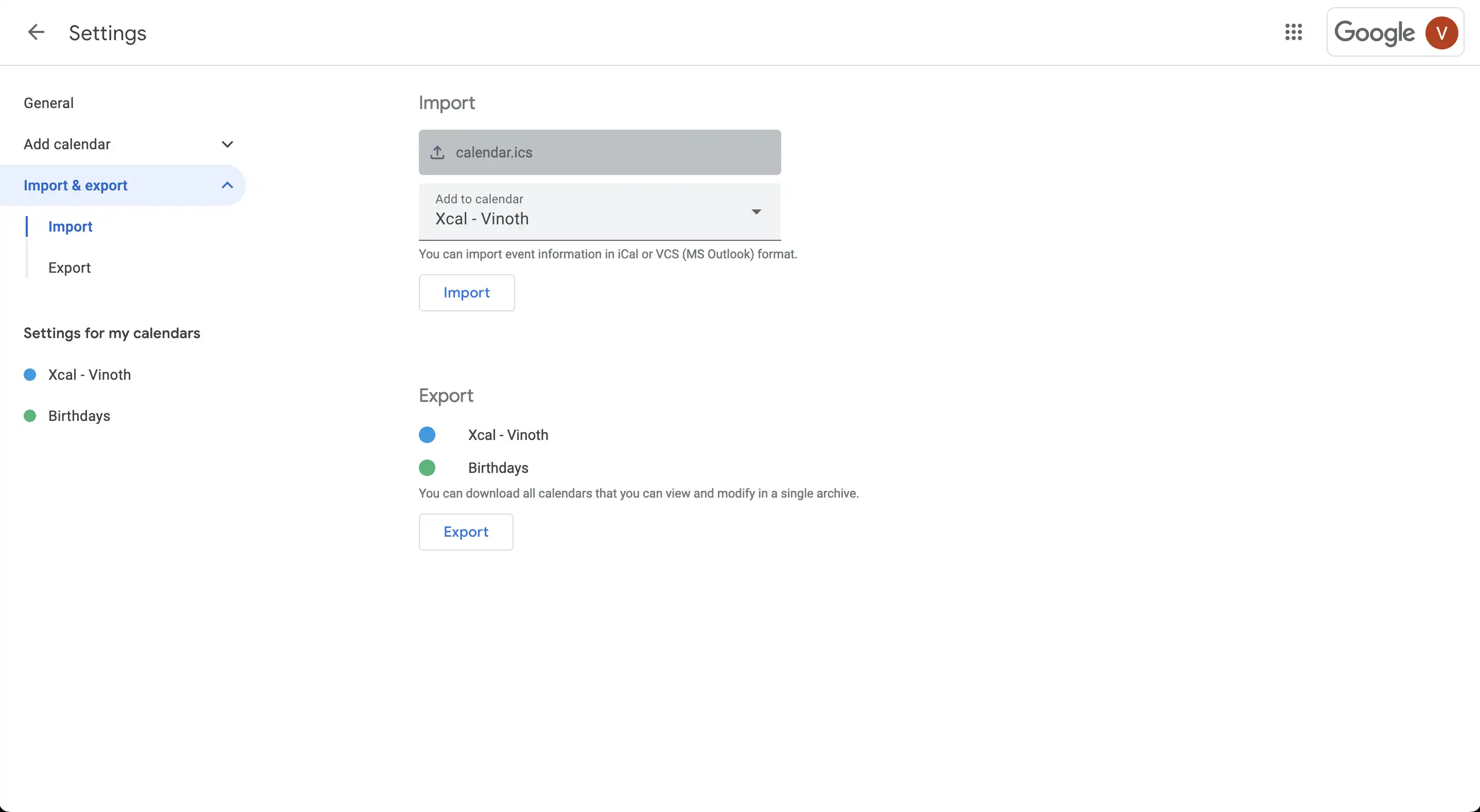
From the left menu, click Import & export.
-
Click Select file from your computer and pick the
.icsyou downloaded. -
Choose the destination calendar from the dropdown — by default it imports into your primary calendar, but you’ll usually want a separate calendar (e.g., “Work” or “Outlook import”) so you can hide or delete it later.
-
Click Import.
-
Google reports
X events importedonce it finishes. Large calendars (5,000+ events) can take a minute or two.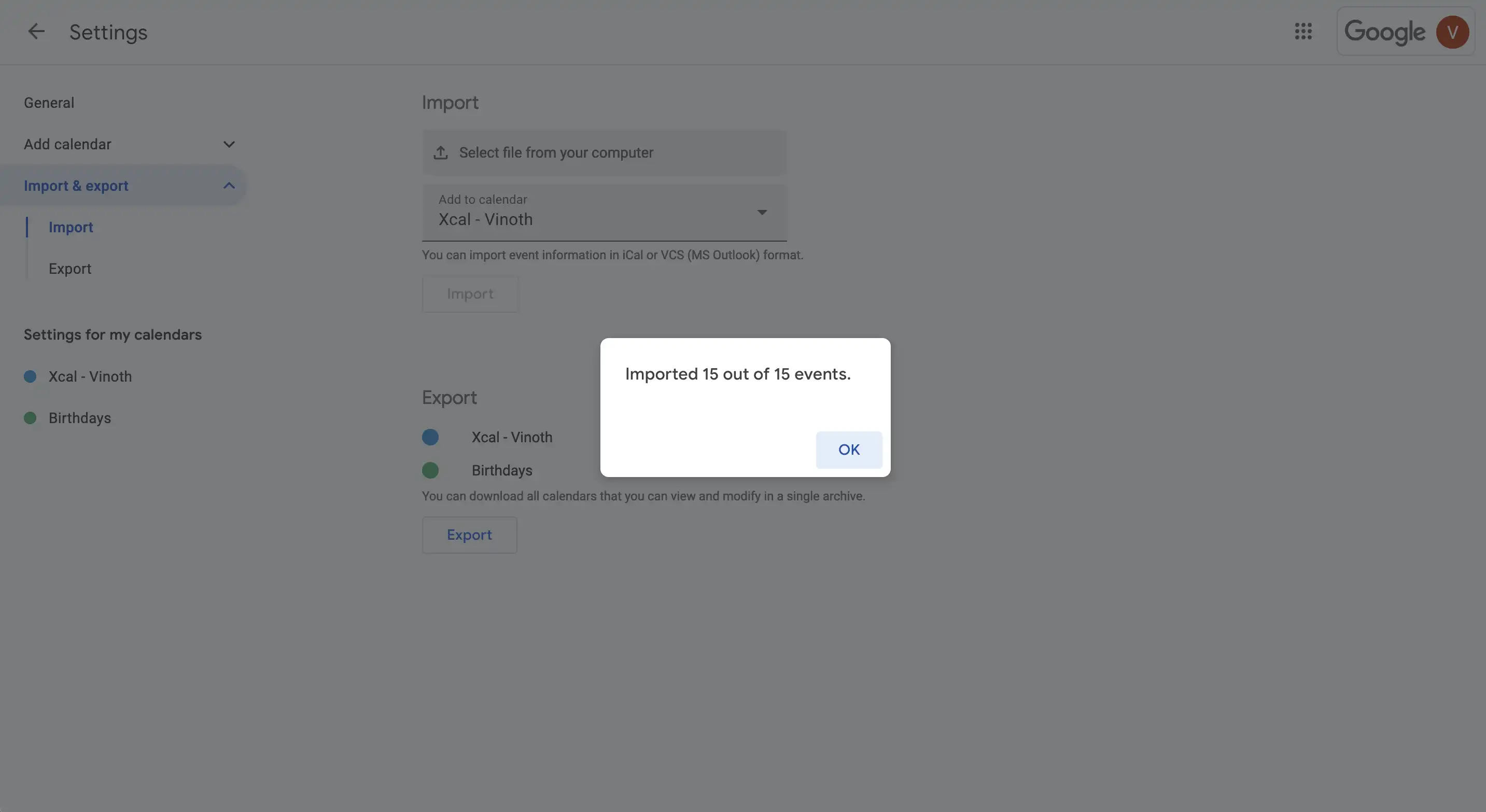
That’s the entire flow. Spot-check a handful of recurring meetings in the next section — those are the events most likely to import incorrectly.
Method 2: Read-only subscription URL
If you need ongoing visibility (not just a one-time copy) but don’t need to edit Outlook events from Google, you can subscribe Google to the published Outlook ICS URL.
- In Outlook, follow steps 1–4 of Method 1 but don’t click Download — instead, copy the ICS link.
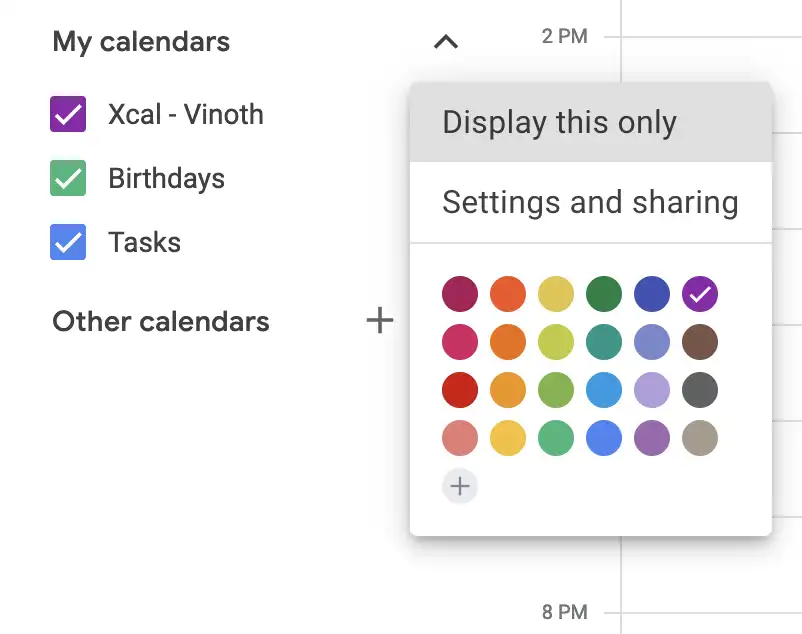
- In Google Calendar, click the + next to Other calendars in the left sidebar and choose From URL.
- Paste the Outlook ICS URL and click Add calendar.
A new entry appears under Other calendars with the synced events. The catch: Google fetches subscribed calendars on its own schedule, typically every 8–24 hours, and you can’t trigger a manual refresh. If your colleague creates a meeting in Outlook at 9am, it might not appear in Google until tomorrow.
The other limitation: events from a subscribed calendar are read-only in Google. You can see them but can’t edit, accept, or decline. They also don’t trigger Google’s notifications for upcoming events the same way native events do.
Method 3: Automatic sync with XCalSync
For most people who care enough to read this article, what they actually want is two-way sync — edit an event in either calendar and have the change reflect in the other within minutes, with control over which events copy and how their details appear.
That’s what XCalSync does:
- Authenticated, near-real-time sync: connects via OAuth to both Google and Microsoft, polls both sides every few minutes. No public ICS URL to leak.
- Two-way sync option: changes in either calendar replicate to the other.
- Event filtering: copy only events on selected days of the week, only events matching a name pattern, or skip “tentative” responses.
- Anonymization: replace event titles with “Busy” in the destination so colleagues see availability without reading meeting details.
- Buffer time: automatically add a 15-minute buffer before/after copied events to account for travel or context-switching.
Setup takes about five minutes:
- Sign up at app.xcalsync.com.
- Click Add account, pick Google, and grant calendar access.
- Click Add account again, pick Outlook, and authorize.
- Create a SyncPair: source calendar → destination calendar, choose direction (one-way or two-way), pick filters.
- XCalSync handles the rest, sending you a digest each time a sync completes.
The free tier covers a single SyncPair. Upgrades start at $4/month.
Troubleshooting common import problems
”Failed to import events” or “Format not recognized”
Open the .ics in a text editor — it should start with BEGIN:VCALENDAR. If it starts with anything else, the file is corrupt or you grabbed the HTML preview instead of the ICS link. Re-download from Outlook and try again.
Duplicate events after import
Google doesn’t dedupe on import — re-importing the same .ics creates a second copy of every event. The fastest cleanup is to import into a separate calendar (not your primary), then delete the whole calendar if you need to redo it. Recovering from a mistaken import into your primary calendar is painful.
Recurring events show only one occurrence
This usually means the .ics file contains a recurrence rule Google doesn’t fully support. The most common offender is an Outlook custom recurrence with exceptions (e.g., “every Monday, except for the third Monday in months with five Mondays”). Edit the original event in Outlook to a simpler recurrence pattern, re-export, and re-import.
Events appear at the wrong time
Time-zone mismatches. Outlook embeds the event’s source time zone in the ICS; Google interprets it relative to your Google account’s time zone. If your two accounts have different time zones, events will look shifted. Fix by aligning the time zones in both accounts, then re-importing.
”Publish a calendar” is greyed out in Outlook
Your Microsoft 365 tenant has disabled external sharing. Either ask IT to enable it for your account, or use the Outlook desktop Save Calendar export instead (it bypasses tenant publishing rules).
Things to check before you import
- Time zone: confirm both Outlook and Google use the same time zone, or expect shifted events.
- Calendar separation: import into a dedicated Google calendar, not your primary, so you can roll back without losing native Google events.
- Privacy review: ICS files contain full event details. If your Outlook calendar has confidential meetings, decide whether to skip those by exporting a filtered date range from Outlook desktop.
- Workspace policies: for work accounts, check whether your IT team allows external calendar sharing before publishing.
- Event volume: Google Calendar caps imports at around 5,000 events per ICS file. Larger calendars need to be split or imported in date-range chunks.
What manual import doesn’t give you
The export/import method works for a one-time migration. It falls apart for ongoing use:
- It’s a snapshot. Edits, new events, and cancellations after the export don’t propagate.
- It’s all-or-nothing. You can’t pick which events copy. Personal appointments end up in your work calendar and vice versa.
- It’s lossy. Exceptions in recurring events, attendee responses, attachments, and Microsoft-specific event properties (like Teams meeting links) often don’t survive the round trip.
- There’s no recovery path. If you import twice or to the wrong calendar, untangling duplicates is a per-event chore.
If any of those matter for your use case, XCalSync handles them automatically. If you only need to migrate historical events once and never look back, the manual ICS import is fine.
Get started with XCalSync — free, no credit card required.
Frequently asked questions
- Yes, but not with the built-in tools. The native Outlook export and Google Calendar import is a one-time copy — any future Outlook changes won't appear in Google. For automatic ongoing sync you need either a read-only ICS subscription URL (delayed by Google's 8–24 hour fetch interval) or a sync tool like XCalSync that polls both sides every few minutes.
- Out of the box, no. Google Calendar can subscribe to a published Outlook calendar and Outlook can subscribe to a Google Calendar URL, but both are read-only — events imported this way cannot be edited in the destination calendar. True two-way sync (where editing in either calendar updates the other) requires a third-party tool.
- Google fetches subscribed external calendars on its own schedule, typically every 8–24 hours. There is no way to force an immediate refresh. If you need near-real-time sync, the subscription method is not suitable.
- Often yes, but check with your IT admin first. Many organizations restrict calendar publishing or third-party app access through Microsoft 365 admin policies. If 'Publish a calendar' is greyed out in Outlook on the web, your tenant has disabled external publishing and you'll need either admin approval or an authenticated sync tool.
- The export-to-ICS flow requires the 'Publish a calendar' feature, which is controlled by your Microsoft 365 sharing policy. Personal outlook.com accounts always have it; Microsoft 365 work and school accounts may need an admin to enable external sharing in the Microsoft 365 admin center.
- Most recurring events transfer fine, but edge cases break. Series with custom exceptions (e.g., 'every Monday except Dec 25'), recurrences spanning a daylight-saving-time change, and events created with Outlook desktop's older formats sometimes import as a single instance instead of a series. Spot-check recurring events after import.
- No. Imported events are added to your calendar without sending RSVPs or notifications to original attendees. Attendee lists are preserved as text but the events are no longer linked to the original meeting in Outlook — replies and updates won't sync between the two systems.
- The ICS export and subscription methods always include all event details — title, location, attendees, body — for any event in the published calendar. To filter or anonymize sensitive events you need a sync tool with field-level controls (XCalSync supports event filtering by name, attendee, day, and lets you replace titles with a generic label like 'Busy').